
The reform of municipal finances urgently needs an update
To avoid sending the wrong signals, the financial burden on municipalities must be shared more fairly, argues local politician Néckel Polfer in a guest contribution.
Luxembourg voted, twice in one year. But for many municipalities, the most important election was probably the national election: because it will now become clear whether municipal finances become fairer, or whether residents of rural municipalities remain second-class citizens.
The 2017 reform
The goal of the 2017 reform of municipal finances was to bring all Luxembourg municipalities back to a similar financial level. At the time, revenues varied so widely that a reform was necessary; and indeed, many municipalities benefited from the reform. However, the new rules also produced many distortions, which led to new inequities and which even call into question Luxembourg's long-term economic competitiveness.
The new inequities
The new distribution formula includes many complicated compensation mechanisms. Municipalities with high business-tax revenues now keep only a smaller, capped share — the rest flows into the FDGC (Fonds de Dotation Globale pour les Communes). The FDGC in turn distributes the funds to the municipalities, with population size being the primary factor. However, what is used here is not the actual population, but the "adjusted population" ("population ajustée").
This calculation factors in population density (the denser, the better), but what matters above all is whether a municipality lies within a CDA (Centre de Développement et d'Attraction). In plain terms, this means that a resident of the capital is worth roughly one and a half times as much as a resident of a rural municipality; a resident of Esch/Alzette is worth about 25 percent more. This clearly disadvantages rural municipalities, especially since their costs per resident (above all for infrastructure and transport) are also higher.
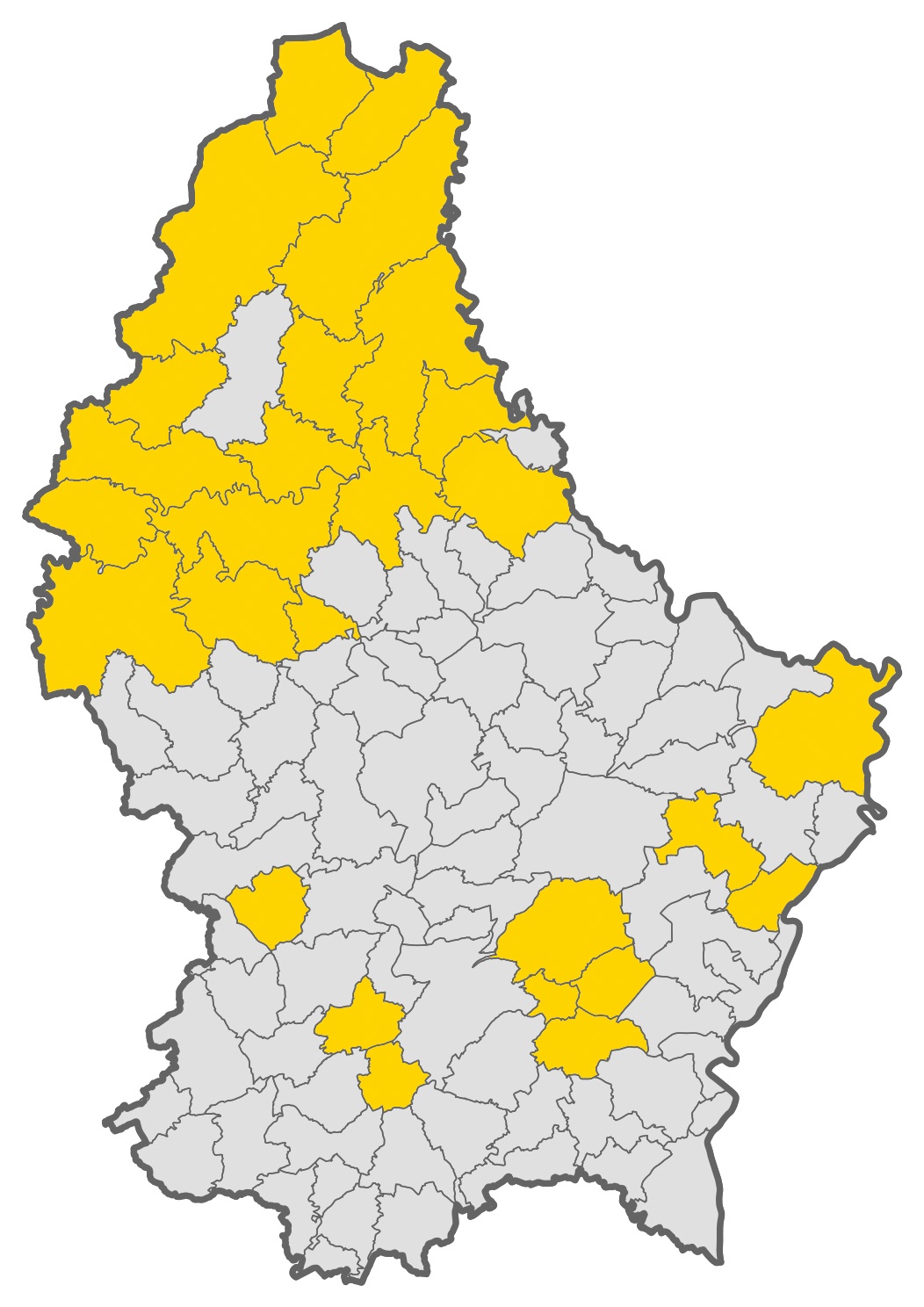
The financial contribution of municipalities to the Fonds de l'Emploi (which funds, among other things, unemployment support) looks even more unjust. Looking at the map, one sees that the rural municipalities in the north make up the large majority of net contributors for the year 2022 (yellow municipalities, see chart). And these are truly not the wealthiest municipalities in the country. Why does the city of Luxembourg, by far the richest municipality (per capita), not pay a single euro into the Fonds de l'Emploi? Because it can spread its large income across an inflated (adjusted) population, and is thus classified as poorer. Because of this distorted statistic, rural municipalities pay far more than their fair share.
Consequences for rural municipalities
Nationally, the municipal contribution to the Fonds de l'Emploi is a manageable sum of 20 million euros. For a small municipality, however, the amounts can be crushing. Weiswampach, for example, paid 1.7 million euros into the Fonds de l'Emploi in 2022, out of revenues of 10.2 million euros. That amounts to a reduction of the budget by more than 16 percent, or more than 750 euros per resident. Incidentally, payments to the Fonds de l'Emploi are higher than the revenue from the business tax (1.2 million euros), which means that the many economic activities in the municipality actually represent a net loss — at least for the municipal finances. This has nothing to do with "social justice," but rather with retribution. These funds are then in turn missing for investments. As a result, twelve million euros of debt have been taken on over the past six years to expand the school and finance other public buildings.
In the end, this situation will lead to over-indebtedness for many municipalities. So far, the response of national policy on this issue has been to encourage, or force, municipalities into mergers. But if even large municipalities in terms of area, such as Wincrange, are going through financially difficult times, one has to wonder how big these municipalities would need to become in order to be viable — the size of a canton, or perhaps the entire Ösling as one super-municipality? That, however, is certainly not going to be popular, not to mention the loss of democratic representation.
The definition of the CDAs is closely tied to national land-use planning, i.e. the PDAT (Programme Directeur d'Aménagement du Territoire). In order to limit land consumption, the country's population growth is meant to be concentrated in a few urban hubs (above all Luxembourg City, the South, and the Nordstad). This means that in rural areas, practically no population growth is supposed to take place anymore after 2035. Given that municipal finances particularly reward high population density, rural municipalities are caught in a bind. To improve their finances, they need population growth, which, however, is being denied to them. In other words: "You are poor, and you should stay that way."
Reforming the reform?
It remains to be seen whether and how the new government will once again revise the rules of municipal finance. A good starting point would be to reform contributions to the Fonds de l'Emploi, so that a handful of sparsely populated municipalities no longer pay the bulk of the contributions. At present, for example, the municipalities of Clervaux, Parc Hosingen, Weiswampach, Wincrange, and Troisvierges (about three percent of the total population) pay 35 percent of the contributions.
Finally, the question also arises as to what extent this large-scale redistribution of funds negatively affects Luxembourg's economic development. For many municipalities, it is no longer worthwhile to attract businesses. But how is the Luxembourg economic model supposed to function if municipalities only want residents, without the corresponding jobs? That is why the caps on business-tax revenue should also be scrutinized. The financial incentive for jobs to be created in a municipality should be preserved. In keeping with the motto: "What is good for the country should also be good for the municipality."
* The author is an alderman ("Schöffe") in the municipality of Weiswampach.