
Luxembourg needs a partner on the path to sustainability
When shifting to a CO₂-neutral economy, the country should be guided by concrete facts rather than wishful thinking, argues guest author Néckel Polfer.
When it comes to energy matters, Luxembourg generally looks for guidance to Germany, supposedly the pioneer in the energy transition, not least because we source a large part of our electricity from there. In Germany, renewables now account for just over half of electricity production on average. The press often reports that producer prices for renewables are already lower than those for fossil energy, making progress seem unstoppable. But the idea that wind and sun are cheap (indeed free) is a fallacy — otherwise, why did German electricity prices rise by 50 percent between 2007 and 2019 alone (i.e. before Covid and the war in Ukraine)?
The real cost of renewable energy
Electricity has the advantage of being usable everywhere, and of being converted very efficiently into other forms of energy. Its disadvantage, however, is that at every single moment exactly as much electricity must be produced as is being consumed. When production and consumption diverge, voltage fluctuations occur in the grid, which in extreme cases can lead to a complete power failure — a blackout.
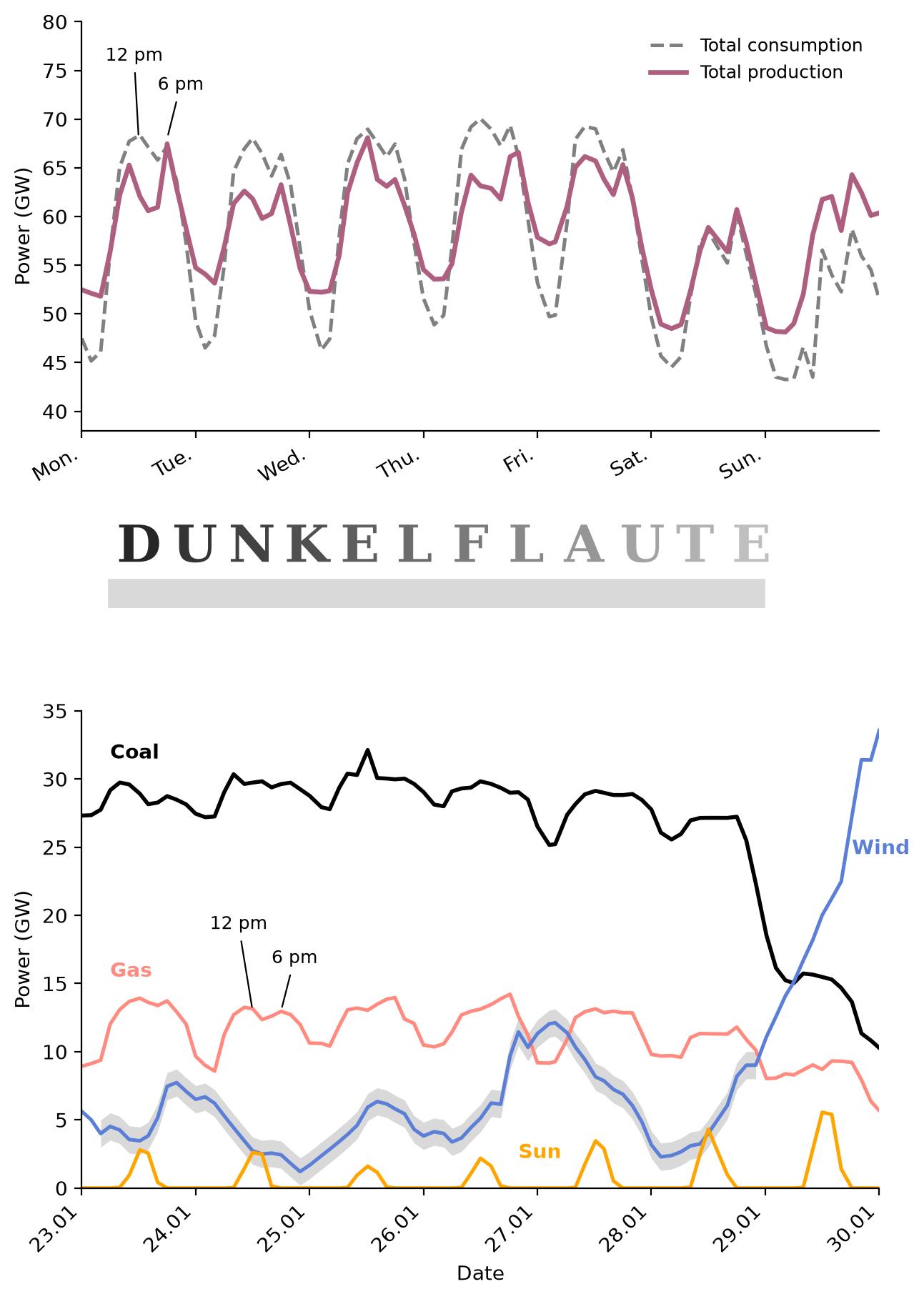
The upper part of the graph shows total electricity consumption and total electricity production over one week in Germany a year ago (January 2023) (1). The wave-shaped daily consumption pattern shows two peaks where demand is particularly high: around midday, and around 6 p.m. in the evening. The volatility and unreliability of renewables are not easily reconciled with the high demands of a stable power grid. Wind does not always blow with the same strength, and solar radiation depends on the time of day, the season, and weather conditions.
Toward the end of January, so-called cold "dark lulls" ("Dunkelflauten") occur more frequently, during which renewable electricity production drops extremely for several days, sometimes even weeks. The lower part of the graph shows the electricity production of the various energy sources during that same week in January 2023, illustrating what a mild dark lull looks like. Solar energy is only available to a very limited extent at this time of year. The share of wind energy stays mostly below 15 percent for several days. Coal and gas power plants have to cover the overwhelming majority (about 70 percent) of electricity generation for more than five days. Only toward the end of the week does wind energy rise to 50 percent of production within a few hours, allowing coal and gas plants to be scaled back.
Electricity production from renewables is by no means matched to consumption, but fluctuates arbitrarily. Because of this volatility, gas and coal power plants must always stand ready as backup energy. The consumer pays for this backup capacity, which in turn explains the higher electricity prices. It is therefore misleading to compare only producer prices instead of the real costs, due to unreliability (2).
The limited possibilities of energy storage
Is it possible to replace fossil power plants with energy storage? Pumped-storage hydropower and batteries are well suited as efficient short-term storage. During a dark lull, however, electricity production (from renewables) falls far below consumption for several days, which is why long-term storage strategies are needed.
Until now, "green" hydrogen has been seen as the great hope for long-term storage. Nonetheless, there are also a number of fundamental limitations here that cannot be solved through technical progress. The double conversion (from electricity to hydrogen, and then back to electricity again), as well as compression and transport, lead to energy losses as high as 90 percent. Producing green hydrogen consumes practically as much energy as one ultimately gets back out from it. This strategy cannot be a solution to our energy problems.
French solutions
So how can the problem of the energy transition be solved in practice? In France, there are in principle two solutions on offer. On the one hand, there is nuclear power: it is generally available and produces no CO₂. The second possibility lies in "white" hydrogen, which has been discovered, for example, several kilometers deep in Lorraine. This hydrogen can then be burned in converted gas power plants, with water as the only waste product. This would then be the CO₂-neutral backup energy. Will Lorraine develop these deposits? To do so, one would presumably have allow the controversial practice of fracking. Since France is already relying on nuclear power anyway, this remains very much uncertain.
Luxembourg is a small country that sources around 80 percent of its electricity from abroad. To achieve the energy transition while maintaining security of supply, we need partners with whom a workable strategy can be pursued. On the one hand, French nuclear power offers us a reliable, CO₂-neutral backup energy. On the other hand, we might perhaps be able to persuade our neighbors in Lorraine to exploit their rich hydrogen deposits — as some politicians already called for during the last election campaign.
* The author holds a Ph.D. in chemistry and is climate alderman ("Klimaschöffe") of the municipality of Weiswampach.
(1) For a detailed compilation of all energy sources: http://www.energy-charts.info
(2) Schernikau, Lars; et al. "Full Cost of Electricity 'FCOE' and Energy Returns 'eROI'." Journal of Management and Sustainability, Vol. 12, No. 1, June 2022.